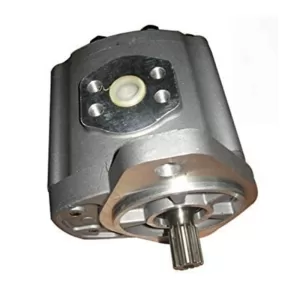
Specifying a hydraulic gear pump for heavy equipment is rarely a matter of matching a flow figure. Two pumps can share a displacement and still differ in shaft spline, flange pattern, port layout, seal material and the pressure they tolerate shift after shift. Get one of those wrong and the machine either will not accept the unit, or will accept it and fail early.
This guide covers what decides fit and service life: how a gear pump generates flow, why large machines use multi-section assemblies, which specifications must match before ordering, and where these units fail first. The last section applies them to one assembly used on an articulated dump truck.
How a Gear Pump Produces Flow
A gear pump moves oil by trapping it. Two meshing gears run inside a close-fitting housing, and as they rotate, oil is carried in the spaces between the teeth from the suction side to the discharge side while the mesh point stops it travelling back. There are no valves in the pumping action and no reciprocating parts, which is why the design is compact, reasonably tolerant of contamination and able to self-prime.
That simplicity shapes the behaviour buyers should expect. Flow is essentially fixed per revolution, so output tracks engine speed rather than demand. The pump pushes oil far better than it pulls it, which makes suction line sizing and oil temperature critical. And because the clearances separating high from low pressure are small, efficiency depends on the sealing surfaces inside the unit.
Why Heavy Equipment Uses Multi-Section Assemblies
Large machines rarely need one hydraulic function at a time. An articulated dump truck, for instance, has to steer, charge a brake accumulator and run auxiliary or cooling circuits while carrying a load. Each of those circuits has its own pressure and flow requirement, and none of them can wait.
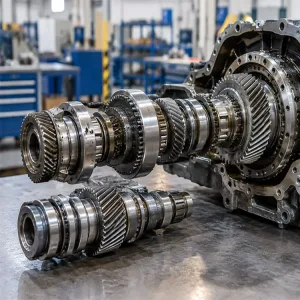
One approach is to mount several separate pumps, each with its own drive, bracket and hoses. The alternative, and the one more common on modern equipment, is a single hydraulic pump built as a monoblock with several gear sections on a common input shaft. One drive point on the engine then feeds multiple independent outlets.
The trade-offs are practical: less space in an already crowded engine bay, one mounting interface instead of several, fewer drive couplings, and a lighter parasitic load. The cost is that service access sits at assembly level — when one section wears, the whole block comes off.
Specifications That Have to Match Before You Order
A pump that looks right on a data sheet can still be the wrong unit. These are the points that decide whether it fits, and how long it lasts once fitted.
Displacement, Flow and Speed
Displacement is the volume moved per revolution, and it sets flow at any engine speed. Buyers start here because it is the number on the label, but it only means something alongside the speed the pump will actually run at. A unit rated for high flow at low speed and one delivering the same flow at high speed are not interchangeable, and over-speeding a pump accelerates gear and bearing wear.
Pressure Rating and Continuous Duty
Gear pumps on heavy equipment work continuously at pressures that would be intermittent duty elsewhere, often above 200 bar for a whole shift. What matters is not the peak figure but the pressure the unit holds without internal leakage becoming a problem. As clearances open with wear, oil slips past the gear tips and flow falls. A unit that is marginal when new will be weak long before the machine is due for overhaul.
Shaft Spline and Mounting Flange
This is where most ordering errors happen. The drive shaft spline has to match the engine auxiliary gear train or PTO take-off, and tooth count, profile and flange pattern all count. Manufacturers change them across build periods, so two pumps from one part family can have different splines. Confirm from the machine identification, not from a photograph of the old pump.
Port Layout, Rotation and Mounting Position
Port position decides whether the hoses reach without being strained, and rotation is not always reversible — a pump on the opposite side of the engine may need the other hand. Space matters too: a monoblock with three sections needs clearance at the centre section as well as the ends.
Seals: Where Pump Performance Is Usually Lost
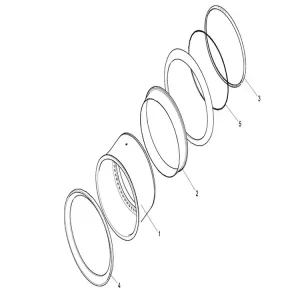
Seals are the cheapest part of the assembly and the one that sets its service life. Three sealing jobs happen inside a gear pump: the shaft seal keeps oil inside the housing at the drive end, the housing O-rings seal the joints between sections, and back-up rings support the seals against pressure and extrusion.
Heat and pressure work on all three. Shaft seals harden and take a set, O-rings swell or flatten, back-up rings lose the shape that keeps them seated. The result is rarely a dramatic failure but a gradual one: an external weep, then internal bypass as the sealing surfaces stop holding, and heavy steering or slow accumulator charging.
This is why a rebuild is only as good as its seal kit. Reusing seals already compressed or softened by hot oil puts the unit back together with the original fault still in place. On any overhaul, the hydraulic pump components that do the sealing should be replaced as a set, matched to the oil and temperature the machine runs at.
Reading the Parts Catalog the Right Way
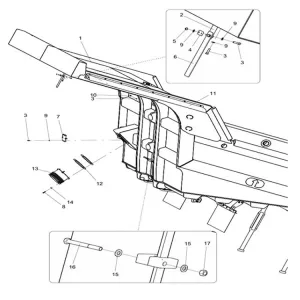
Parts catalogs for heavy equipment are structured, and reading them structurally prevents most ordering mistakes. A pump assembly normally appears as a parent item with a short list beneath it: the seal kit, sometimes shaft or bearing items, and sub-assemblies sold separately. Each line has its own number, and that number, not the description, is what ships.
Two habits are worth building. First, decide whether the job is an assembly or a component replacement, because if the housing or gears are worn a seal kit alone will not restore output. Second, when sourcing heavy equipment spare parts, confirm the numbers come from the manual matching your build, since illustrations are shared across models that do not share parts.
Genuine Parts or Aftermarket: What the Choice Actually Involves
For wear parts, both options can work and the right one depends on the machine role. Genuine parts carry the manufacturer specification, traceability and warranty support, removing doubt about material and tolerance. That certainty has a price and a lead time.
Aftermarket parts vary far more than the category name suggests. A supplier working to original specification can deliver seals and gears that perform to the same standard; one working to a price will not. The separating questions are specific: what material is the shaft seal, is the profile pressure-balanced, are the gears surface hardened, and can the supplier state a specification rather than call the part high quality.
Taken together, these points describe a workable specification for a machine that steers, brakes and cools off one accessory drive: multiple sections on one shaft, a spline and flange matching the engine, seals rated for continuous hot oil, and a parts list ordered by number. The section below looks at one assembly built to that pattern.
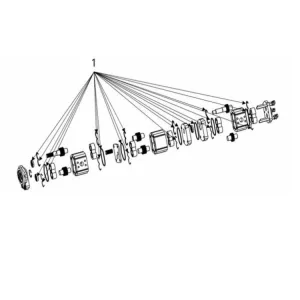
150107020054A Triple Gear Pump Set for the Sany SAT40C
The 150107020054A Triple Gear Pump Set is the engine-driven auxiliary hydraulic pump assembly specified for the Sany SAT40C articulated dump truck. It houses three gear sections in a single monoblock on one common input shaft, and bolts onto the engine auxiliary gear train or PTO port. Because it is listed among Sany parts for this model, the part number, not the name, is what identifies it.
Articulated dump trucks work under continuous heavy load, and rotational torque has to reach the articulation joint, steering, suspension and braking. This assembly feeds three circuits from that one drive point: the primary steering loop, the high-pressure braking and accumulator charging circuit, and auxiliary or fan cooling loops.
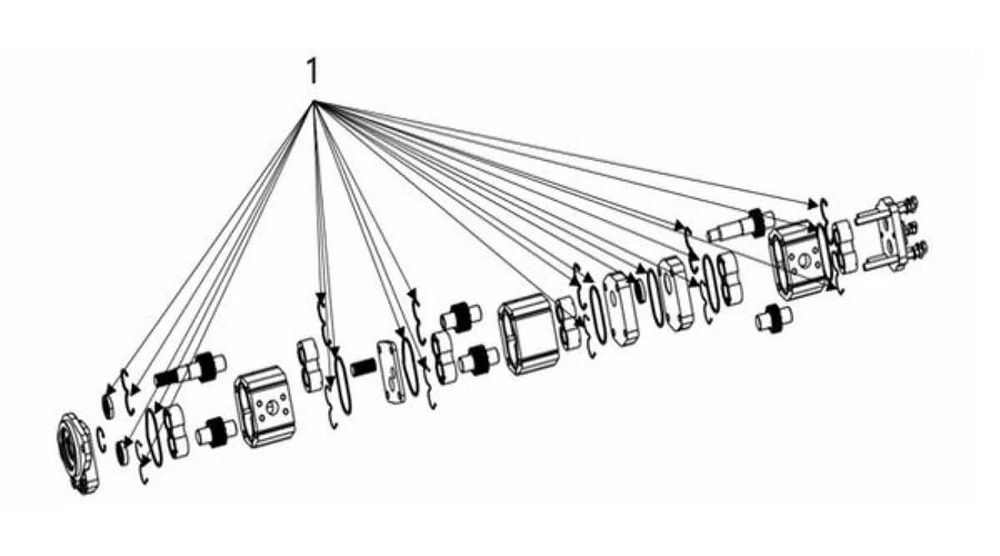
Assembly Specifications
| Attribute | Specification |
| Assembly Part Number | 150107020054A |
| Assembly Name | Triple Gear Pump Set (Hydraulic Triple Gear Pump Assembly) |
| Compatible Brand | Sany |
| Applicable Machine | SAT40C Articulated Dump Truck |
| Category | Sany Articulated Dump Truck Hydraulic System Parts |
Assembly Component Parts List
| Index | Part Number | Description | Qty |
| 1 | 150107020054A001 | Kit, Seal (Hydraulic Pump Rebuild Seal Kit) | 1 |
What the Assembly Is Built to Do
Multi-section delivery. Three gear sections in one monoblock give three independent pressure outlets from a single drive input, saving engine bay space and reducing the auxiliary load on the drivetrain.
Fluorocarbon seal kit. The 150107020054A001 kit uses high-performance fluorocarbon shaft seals and pressure-balanced gaskets built for extreme oil heat and friction, which is what holds internal bypass and external leaks in check.
Hardened gear assemblies. Internal spur gears are machined to tight clearances and surface hardened, keeping flow stable and noise low under the ground shocks mining work produces.
Ordering and Rebuild Guidelines
Verify the spline before shipping. Sany auxiliary engines use different gear ratios and mounting flanges across builds. Supply the chassis serial prefix or the engine identification plate so the spline tooth count and flange pattern can be confirmed against your SAT40C.
Replace the full seal kit on any rebuild. Gear pumps are highly sensitive to internal pressure bypass. Reusing flattened or oil-swollen seals puts the unit back together with reduced hydraulic pressure output.
Purge the lines at installation. Air pockets in the main hydraulic lines cause localised cavitation and pressure shocks that damage internal gear teeth and bushings. After fitting the pump, bleed the air from the lines before running the steering and braking systems under full load.
Frequently Asked Questions
What machine is the 150107020054A pump set designed for?
It is specified for the Sany SAT40C articulated dump truck, serving the primary steering loop, the braking and accumulator charging circuit, and auxiliary or fan cooling loops.
Does the assembly include the seal kit?
Yes. The assembly listing includes the primary rebuild seal kit, part number 150107020054A001, which can also be ordered separately for routine overhauls.
Can I order the seal kit on its own?
Yes. The seal kit is the separately orderable item in the assembly breakdown, and it is supplied in both genuine Sany OEM and aftermarket options.
How do I confirm the pump will fit my truck?
Provide the chassis serial prefix or engine identification plate. Sany auxiliary engines differ in gear ratio and flange pattern, so both are checked against the machine before shipping.
Conclusion
A gear pump decision comes down to four things: whether the displacement suits the circuit, whether the spline and flange match the engine, whether the seals will hold under continuous hot oil, and whether the part can be ordered and traced by number. On a machine that works every shift, that difference is settled at the ordering stage rather than in service.
The 150107020054A Triple Gear Pump Set addresses the Sany SAT40C as a complete three-circuit block, with its rebuild seal kit available separately.
Looking for a hydraulic gear pump assembly or its rebuild seal kit? Send the part number 150107020054A, your required quantities and delivery port, and our B2B sales team will return a formal commercial quotation within one business day.