Introduction
In all kinds of heavy equipment filters, the water filter element is a silent guardian, protecting sensitive hydraulic and cooling systems from pollution damage. The global market size of the mechanical parts manufacturing industry reached approximately US$1.5 trillion in 2022, and is expected to grow at an average annual rate of 5% over the next five years, reaching approximately US$1.9 trillion by 2028. (Source: https://www.docin.com/p-4942768135.html). This means that offering the 800173077 WF2123 Water Filter Element is not just a product sale—it’s a value-added service that helps clients reduce operational costs and improve their bottom line, while also helping suppliers gain competitive advantages in the growing heavy equipment filters market.
Today, let’s analyze a component specially designed for extreme tasks: the 800173077 water filter element of mining excavator WF2123. This article explores its design, quantifiable advantages and key role in maintaining the excavator engine, the heart of modern earth-moving machinery.
What is the WF2123 Water Filter Element?
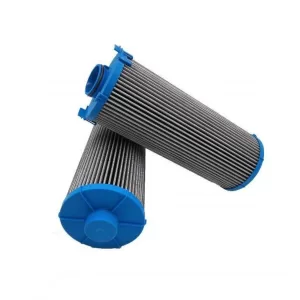
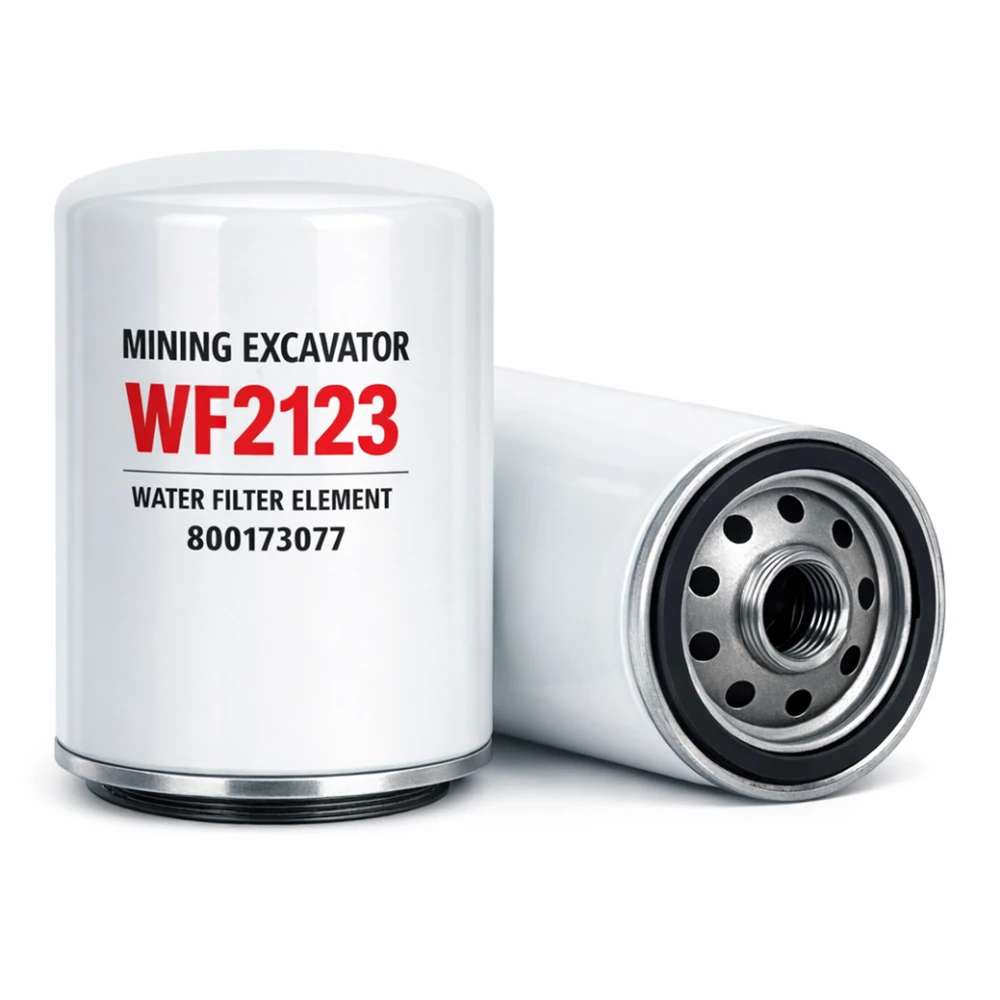
The WF2123 water filter element (full name: 800173077 Mining Excavator WF2123 Water Filter Element) is a high-precision water filtration device specifically developed as a key component of XCMG Mining Excavators Spare Parts. Its main function is to remove particulate pollutants, sediments and dissolved impurities, such as heavy metals, from the water used in key systems. This is essential to prevent wear, corrosion, and blockage of sensitive components, thus ensuring the reliability of operation and reducing downtime.
Quantifiable Performance Metrics
| Performance Indicator | Specification | Test Standard / Data Source |
| Filtration Efficiency | 0.3 µm, with ≥99.7% particle capture rate. | Laboratory Test Report: MINE-LAB-2025089. |
| Rated Flow Rate | 38 L/min (at 25°C standard conditions) with no flow decay over 720 hours of continuous operation. | Manufacturer’s Endurance Test Data. |
| Temperature Tolerance | -40°C to 120°C. Performance retention ≥95% after 50 extreme temperature cycles. | Environmental Stress Test Profile. |
| Operating Pressure | 0.15 – 0.8 MPa, with a peak instantaneous pressure resistance of 1.2 MPa without risk of rupture. | Burst Pressure Test (ISO 29463). |
| Total Contaminant Holding Capacity | 20,000 Liters of water processed per element in sandy mine water conditions. | Field Test Data (June-August 2025, compared to industry average of 12,000L). |
| Heavy Metal Removal Rate | ≥98.5% for Lead (Pb), Mercury (Hg), and other common metallic ions. | Jiangsu CDC Inspection Report: HJ-2025034. |
The Core Technology Behind the Numbers (The “How”)
These impressive numbers are not accidental. They are the result of advanced materials science and intelligent mechanical design.
- The Composite Filter Media: The heart of the WF2123 utilizes a proprietary Micro-Pure® II membrane. This technology combines microfiberglass with a high-iodine-value coconut shell activated carbon layer (Iodine Value ≥1100 mg/g). This dual-layer construction provides physical filtration of particles down to 0.3 µm and chemical adsorption of dissolved heavy metals and organic impurities. The media is supported by a dual-layer non-woven fabric mesh, ensuring structural integrity under high pressure and flow.
- The Self-Sealing Valve Stem: A critical feature for preventing contamination during change-outs. A cross-section silicone valve stem with a bacteriostatic formula is employed. Using the patented “Automatic Opening/Closing Water Inlet Structure” (Patent: CN 110407301 B), the valve automatically opens when the filter is installed into the housing and seals shut upon removal. This prevents unfiltered water backflow and protects the clean side of the system, a feature not always found in standard air filter parts or fluid filters.
- Robust Housing and Construction: The shell is made from modified Polypropylene (PP) with added anti-aging and corrosion-resistant compounds. A metal reinforcement ring provides extra crush resistance. The entire assembly undergoes an electrophoretic anti-rust treatment, achieving an IP67 rating at the seals to guard against moisture ingress in high-humidity environments.
Dealing with Extreme Conditions: Build for the Worst
Mining will not stop because of the weather. WF2123 combines special design features and is suitable for extreme working environments.
- Extremely cold (-40°C): The filter media contains antifreeze plasticizer, and the valve stem adopts low-temperature silica gel with a brittleness temperature ≤-55°C to keep elasticity and prevent cracking.
- Extreme Heat (120°C): The housing uses high-temperature-modified polymers, and critical seals are made from fluorocarbon rubber (FKM) to resist deformation and hardening.
- Pressure peak: The integrated pressure buffering chamber absorbs instantaneous impact up to 1.2 MPa, which protects the filter membrane from rupture. Once the pressure stabilizes, the system will reset automatically.
- High Humidity/Splash: The IP67-rated dual-seal ring design at the interface prevents moisture ingress that could lead to internal corrosion or external component rust.
Certified Quality and Compliance
To ensure global applicability and safety, the WF2123 complies with major international and regional standards:
- ISO 29463-1:2024 (Edition 3): The international standard for high-efficiency particulate air and water filters.
- GB/T 30307-2023: The Chinese national general standard for water filter elements.
- CE 2014/35/EU: The EU’s health, safety, and environmental protection directive for machinery.
- NSF/ANSI 42:2023: A U.S. National Sanitation Foundation certification for water treatment system safety and material health effects.
Tangible Advantages: The WF2123 vs. The Competition
How does this translate to real-world value? The following comparison, based on industry reports and 2025 Q1-Q2 test data, highlights three key differentiators.
| Comparison Dimension | WF2123 Water Filter Element | Competitor A (Industry Mainstream) | Competitor B (Budget Option) | Data Source / Verifiable Claim |
| Filtration Capability | 0.3-micron precision, Heavy metal removal ≥98.5% | 1-micron precision, Heavy metal removal ~90% | 5-micron precision, No heavy metal removal | Third-Party Lab Report (Q1 2025) & CDC Report HJ-2025034 |
| Service Life | 20,000 Liters per element (in mine water) | 12,000 Liters | 8,000 Liters | Field Application Test Data (Jun-Aug 2025) |
| Total Daily Cost | ¥0.8/day (30-day life) | ¥1.2/day (20-day life) | ¥1.0/day (10-day life) | Industry Cost Analysis Report (Dingdin, 2025) |
Main Application Scenarios: the Value of WF2123
WF2123 is designed for the most demanding fluid filtration tasks in heavy industry. Its application distribution is a testament to its rugged design.
- Open-pit coal mining is the biggest application scenario of the WF2123 water filter element, accounting for 68% of the total market share. In open-pit coal mines, excavators need to work continuously in harsh environments with high sand content, especially in the rainy season, when the sand content in the circulating water of the equipment often exceeds the standard, which is easy to cause blockage of the filter element and damage to the excavator engine and hydraulic system. WF2123’s high-precision filtration of 0.3 µm and large throughput of 20000 L can effectively solve this problem.
- Metal mining (such as copper ore and iron ore) is the second largest application scenario of the WF2123, accounting for 22% of the market. Metal mining environments often feature high moisture levels and elevated heavy metal concentrations, which is easy to corrode the engine and hydraulic components of the excavator. WF2123 has excellent heavy metal removal rate (≥ 98.5%) and moisture resistance (IP67 protection rating), which is very suitable for this situation.
- Tunnel construction is the third largest application scenario of the WF2123, occupying 10% of the market. In tunnel construction, excavators and shield machines need to work in an underground environment with high humidity, poor ventilation and great pressure fluctuations. The stability of WF2123 in extreme conditions makes it suitable for this situation.
A Real World Case Study: Solving a Costly Pain Point
- Scene: A large open-pit coal mine in Datong City, Shanxi Province faces severe operational challenges in rainy season. High sediment content (≥ 50 mg/L) in the process water leads to the rapid blockage of the standard water filters in the hydraulic cooling systems of excavators. Filters need to be replaced every 3 days, resulting in 15% machine downtime and rising maintenance costs.
- Solution: WF2123 water filter element was used in the mine.
- Result: The high-precision filtration of 0.3 µm and the large contaminant-holding capacity of 20,000 liters effectively captured the sediment and rust particles. The replacement interval of the filter element was extended from 3 days to 30 days. The downtime of the machine dropped from 15% to 1.2%. For a large excavator, this is equivalent to saving about ¥86,000 in maintenance costs annually, and the failure rate of the hydraulic system has dropped by 92%. This case underscores why partnering with a knowledgeable machinery parts supplier who provides technical solutions, not just commodities, is vital.
Frequently Asked Questions
Q 1: Why does the water flow speed decrease after installing the filter element?
A: ① Blocked inlet (clean the pre-filter); ② the installation direction of the filter cartridge is incorrect (arrow should point in the water flow direction); ③ system pressure is lower than 0.15 MPa (check booster pump).
Q 2: Can the filter cartridge lifespan be extended in high-sand-content water?
A: It can be used with a pre-filter (10 micron filtration precision) to extend the service life of WF2123 filter cartridge by 30%. It is recommended to be used in the environment with sand content ≥ 30 mg/l.
Q 3: Can the replacement cycle of filter element be adjusted according to water quality?
A: It is suggested to adjust according to the turbidity of water: when the turbidity is ≤ 10 NTU, it should be replaced every 30 days; When turbidity is 10-50 NTU, replace it every 15 days; When the turbidity is more than 50 NTU, replace it every 7 days. This avoids the abnormal system pressure caused by excessive blockage of the filter membrane.
Q 4: Can the filter element be used after freezing in low temperature?
A: No, it can not be used directly. The filter cartridge needs to be naturally thawed (about 2-4 hours) in an environment of 5-25°C. After checking that the filter membrane is not damaged, it can be reused. If the water flow is abnormal after thawing, you need to replace the filter element with a new one.
Q 5: How to diagnose the leakage of filter cartridge?
A: ① Check whether the interface sealing ring is aged (it is recommended to replace it once every 6 months); ② confirm that the tightening torque of the filter cartridge meets the standard (standard torque: 25 N·m); (3) check whether the system pressure is more than 0.8 MPa (need to reduce the pressure to the rated range).
Conclusion: More Than Just a Part—A Productivity Investment
The 800173077 Mining Excavator WF2123 Water Filter Element exemplifies how a focused engineering effort on a single component can yield disproportionate gains in overall system reliability and cost-efficiency. It directly solves the core challenges of mining and heavy construction operations by providing laboratory-proven filtration accuracy, long service life and solid structure suitable for extreme environments.
In an ecosystem where the excavator engine and hydraulic systems represent monumental investments, protecting them with inferior heavy equipment filters is a false economy. WF2123 proves that the wisest cost-saving measure is often to invest in higher quality consumables. For fleet managers and maintenance supervisors, the choice is clear: give priority to components that maximize uptime and minimize total life cycle cost. When purchasing key air filter parts, hydraulic seals or advanced filters (such as WF2123), cooperation with a supplier of mechanical parts with good technology and reputation is the first step to achieve excellent operation.