Chapter 1: Preface — The Last Defensive Line For Full-Load Mining Working Conditions
Open-pit coal mines, metal mines, and aggregate extraction sites face harsh working conditions such as extreme temperature fluctuations, frequent high-pressure hydraulic shocks, corrosive rock dust, and long-term heavy-load vibrations. In global mining operations, localized seal failure, including failures within hydraulic seal kits, is identified as the most common cause of unplanned equipment downtime. According to the International Commission on Mining and Metals (ICMM) 2026 Global Mining Equipment Maintenance Report, for off-highway mining dump trucks in the 80-150 ton range, the average daily downtime loss due to a single oil seal failure ranges from US$6,200 to US$28,500. This loss covers hydraulic oil contamination, planetary reduction gear wear, labor maintenance costs, and losses caused by on-site dispatch disruptions. (Source: https://www.icmm.com/en-gb/data/global-datasets/mining-metals-facilities).
Chapter 2 Technical Snapshot: Technical Specifications Overview
| Inspection Item | XCMG 800372602 Verified Core Technical Parameters |
| Applicable Vehicle Models | XCMG XDM80, XDM100, XDM150, 80-150 ton off-highway mining dump trucks; matched for wheel-side reducer, lifting hydraulic cylinder, steering cylinder sealing position |
| Onsite Service Lifespan | 12,000 hours continuous mining onsite operation without functional failure; average lip abrasion volume ≤0.02mm per 5000 working hours |
| Extreme Working Resistance | Stable working temperature: -40℃~120℃; static pressure resistance 35MPa, dynamic circulating pressure resistance 25MPa |
| Integrated Raw Material Configuration | Modified FKM fluororubber + nano wear-resistant filler main lip; 1.2mm thick anti-rust steel framework; built-in 304 stainless steel constant tension spring |
| Patented Structural Advantage | Chinese Invention Patent ZL 202010608696.1: composite support ring structure, anti-eccentric wear performance improved by 60% compared with common hydraulic seal kits |
| High-Precision Sealing Index | Zero leakage status sustained when shaft runout ≤0.3mm; external mineral dust intrusion volume ≤0.1g/h under standard dust environment |
| Full Life Cycle Economic Index | Average comprehensive operating cost 0.023 CNY per working hour; equipped vehicles overall attendance rate increased by 12% after replacement |
Chapter 3 Material Science: Solve Seal Premature Aging From Molecular Formula Level
More than 70% of premature mining oil seal failures, including lip cracking, elastic attenuation, rubber delamination, and media swelling, originates from an inferior rubber molecular formula and unqualified framework anti-corrosion treatment. XCMG R&D team optimizes material composition targeting mining vibration, temperature fluctuation, and oil immersion scenarios, upgrading basic material performance compared with conventional customized hydraulic seal kits and bulk China gaskets.
3.1 Modified FKM Fluororubber Molecular Optimization Technology
The main sealing lip adopts customized modified FKM fluororubber blended with nano silicon carbide wear-resistant filler, Shore A hardness controlled steadily at 75±5 per batch production standard. To improve material durability, R&D staff adds ozone-resistant anti-aging auxiliary agent into the rubber polymer chain, optimizing cross-linking density of rubber molecules. Verified by 50pphm×72h ozone aging standard test, the modified FKM material generates no surface crack, with overall oil resistance, high temperature tear resistance, and deformation recovery capacity improved by 40% versus ordinary fluororubber adopted by regular China gaskets.
High-temperature elastic retention core data: Under a 120℃ long-term continuous operating environment, the modified FKM main lip retains more than 90% of its original elasticity; after a 120℃×70h thermal aging test following GB/T 7759 standard, compression permanent deformation is controlled ≤8%. This material design helps prevent permanent deformation of the sealing lip and sealing gap expansion caused by high-temperature softening, which is the core material guarantee for stable lubrication of mining truck planetary gear reduction cavities. Meanwhile, tested by the ASTM D471 standard liquid immersion experiment, the material volume expansion rate keeps ≤3% after contacting mining hydraulic oil, gear lubrication oil, and onsite emulsified dedusting liquid, avoiding size swelling induced seal clamping failure.
3.2 Framework Anti-Corrosion Full Process Treatment Technology
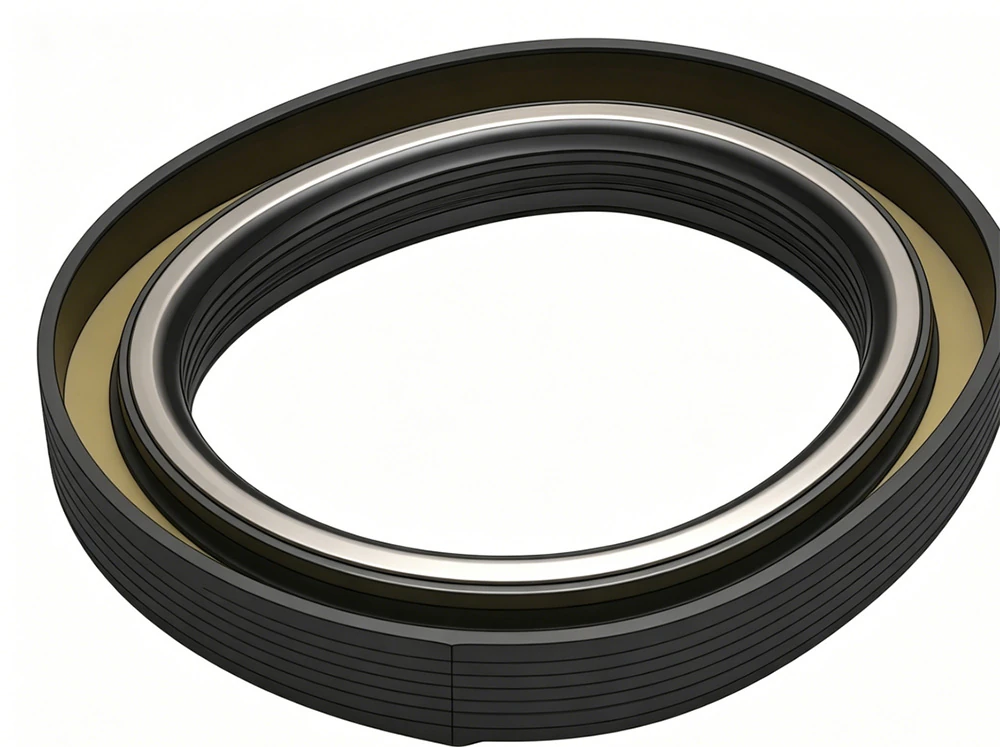
Most low-cost heavy equipment spare parts oil seals adopt thin ordinary iron sheet without anti-corrosion coating, easy to rust, peel, and separate from the rubber body under 95% high humidity rainy mining environment. XCMG 800372602 adopts a 1.2mm thick high-strength SPCC cold-rolled steel plate as an integral framework base material, implementing two-standard anti-corrosion integrated processing: phosphating base treatment + electrophoretic finish coating.
The finished framework reaches ISO 12944 C5-M offshore and mining high-corrosion anti-rust grade, suitable for coastal port haulage and rainy mountain mining working conditions. The physical bonding strength between the metal framework and the modified FKM rubber body is≥12N/mm, effectively solving rubber peeling, edge warping, and seal failure caused by long-term vehicle vibration. Matching built-in 304 stainless steel constant tension spring, annual tension attenuation rate controlled ≤8%, providing stable radial clamping force 45±5N for sealing lip all year round, better than carbon steel spring equipped on mainstream cost-oriented hydraulic seal kits.
Chapter 4 Structural Analysis: Patent-Backed Self-Lubricating Sealing Mechanism
Ordinary single-lip mining oil seals rely purely on spring clamping force to complete static sealing, unable to adapt to axial offset and shaft jumping generated by mining truck full-load bumping. XCMG 800372602 applies an exclusive mining sealing invention patent, cooperating with a double-lip cooperative defense structure to build an active self-lubricating circulation system, adapting dynamic operating characteristics of heavy-load planetary gear reduction assembly, breaking the structural limitation of traditional flat-type China gaskets.
4.1 Practical Application Of Patent ZL 202010608696.1
Patent Name: A Sealing Structure For Input End Of Rear Drive Axle; Patent No.: ZL 202010608696.1; Application Fixed Position: gap between main sealing lip and outer dust-proof lip of 800372602 integral oil seal.
Core patented structural design: Add an integrated composite support ring with a circumferential axial oil groove inside the seal cavity. In traditional hydraulic seal kits, the drive axle offset load directly acts on the single lip surface, causing unilateral lip eccentric abrasion and rapid local thinning. This patented support ring disperses concentrated shaft jumping offset load uniformly to the whole rubber stress surface, improving overall anti-eccentric wear capacity by 60%. Meanwhile, built-in axial oil groove guides internal gear lubricating oil to form a circulating oil film between the shaft neck and the lip contact surface, realizing passive self-lubrication without external grease supply, reducing dry friction heat generation during high-speed rotation of the planetary gear reduction gear set.
4.2 Double-Lip Barrier Collaborative Working Principle
1. Inner Main Sealing Lip: Driven by a 304 stainless steel constant tension spring, it tightly fits the truck shaft neck surface to form a closed primary sealing belt. It blocks internal hydraulic oil and gear lubricant outward leakage, maintaining stable oil pressure inside the reducer cavity under 25MPa dynamic circulating pressure. Radial clamping force keeps balanced when the shaft jumps ≤0.3mm, achieving a long-term dynamic zero leakage standard for original heavy equipment spare parts.
2. Outer Dust-Proof Lip: Adopts a high-elastic enlarged rubber profile design, shaft neck fitting gap controlled ≤0.05mm. Cooperating with the built-in labyrinth dust isolation structure, it intercepts open-pit coal dust, quartz sand, muddy sediment, and mixed abrasive particles. Under the ISO 12103-A3 standard high-concentration dust test environment, external pollutant hourly intrusion volume ≤0.1g/h, preventing abrasive dust from entering the gear meshing area to scratch gear teeth and seal the inner wall, a performance advantage lacking in assembled ordinary China gaskets.
Auxiliary Backflow Design: Double inner oil return grooves reserved on the main lip inner side, guiding trace permeated lubricating oil back to the reducer oil storage cavity automatically, forming a zero-loss self-lubricating closed loop, lowering lip operating temperature rise within 30℃ during continuous operation.
Chapter 5 Extreme Working Condition Solution: All-Weather Adaptive Operation Design
Global mining sites face diversified extreme working interference: sub-zero frigid plateau in northern Mongolia, high-temperature barren rock open pit in southwest China, high-humidity rainy season metal mines, and impact overload working conditions of full-load climbing ore transport. Targeted at three major extreme risks, including ultra-low temperature, ultra-high pressure, and high dust humidity, XCMG 800372602 carries out targeted structural and material upgrading, possessing stronger environmental adaptability than universal combined hydraulic seal kits and conventional heavy equipment parts sealing pieces.
5.1 Ultra-Low Temperature Anti-Cracking Optimization For Frigid Mining Areas
Most ordinary China gaskets using common fluororubber feature brittle temperature around -30℃, easy to harden, crack, and lose elasticity once meeting northern winter mine startup temperature. XCMG upgrades the main lip to a low-temperature customized modified FKM material, measuring the material’s brittle temperature ≤-45℃ by a low-temperature bending test. For onsite frigid protection, the factory pre-coats special low-temperature compound lubricating grease on the lip contact surface, avoiding rubber rigidification adhesion during cold vehicle startup. It keeps a complete sealing performance stably at -40℃ limit ambient temperature, suitable for year-round operation of XDM series mining trucks in high-latitude cold mines, protecting low-temperature startup oil sealing safety of the planetary gear reduction system.
5.2 High-Temperature Aging Resistance For Long-Term Continuous Operation
Under a 120℃ limit, the ambient temperature generated by the reducer’s high-speed meshing and hydraulic system heat accumulation, the main lip adds a compound high-temperature stabilizer agent in a molecular formula. After long-term high-temperature operation, the rubber elastic retention rate is≥90%, preventing thermal aging surface crazing and lip fatigue fracture. Matching the grooved heat dissipation structure on the seal outer side, actively dissipating friction heat generated by lip and shaft rotation, controlling lip local temperature rise within 30℃, avoiding thermal failure of sealing components in summer nonstop mining fleet operation.
5.3 High-Pressure Impact & High-Humidity Anti-Failure Design
Aiming at frequent bumping, unilateral offset load, and instantaneous pressure surge when mining trucks cross road pits with full load, the oil seal adds an integrated reinforced rib structure at the main lip root, improving overall anti-impact strength by 50%. An integral thickened composite rubber framework bears a maximum 35MPa static instantaneous pressure, effectively resisting pressure impact far exceeding working load, solving framework deformation failure of low-end hydraulic seal kits under overload impact.
For a perennial 95% relative humidity humid mine environment, the glue joint surface between the steel framework and rubber implements an integral waterproof sealing treatment. Long-term field verification has shown that, under high humidity conditions, the equipment did not exhibit metal corrosion or rubber delamination, meeting the needs of continuous operation in open-pit mines and waterfront quarries during the rainy season, and ensuring the stable and reliable service life of the planetary gear reducer throughout the entire maintenance cycle.
Chapter 6 Commercial Value Analysis: Why Original Factory Oil Seal Cuts Total Mining Cost
Mining fleet procurement often falls into a low-unit-price misunderstanding: purchasing cheap generic China gaskets to lower one-time spare parts procurement expense, ignoring frequent shutdown replacement, hydraulic oil pollution, gear abrasion, and indirect loss brought by short-life sealing pieces. This chapter uses third-party verified cost data and real mining customer cases to compare the total life cycle cost of XCMG original parts (item number 800372602), imported brand seal A, and domestic ordinary seal B, thus demonstrating the long-term economic advantages of original spare parts for heavy equipment.
6.1 Horizontal Full Life Cycle Cost Comparative Data
All accounting data sourced from 2026 Global Mining Equipment Seal Procurement Cost Analysis Report, comparison targeted at the same size φ120mm×φ150mm×20mm mining reduction dedicated oil seal:
| Comparison Dimension | XCMG 800372602 Original Oil Seal | Imported Brand Seal A | Domestic Ordinary Seal B |
| Single Piece Procurement Unit Price | 280 CNY/piece | 360 CNY/piece | 220 CNY/piece |
| Effective Onsite Service Life | 12000h no failure | 8000h conventional life | 6000h easy lip wear |
| Hourly Comprehensive Operating Cost | 0.023 CNY/h | 0.045 CNY/h | 0.037 CNY/h |
| Extreme Temperature Adaptability | -40℃~120℃ full range adaptation | Failed below -30℃ ambient temperature | Max static pressure only 20MPa |
6.2 Verified Onsite Customer Application Case (Inner Mongolia Open-Pit Coal Mine)
Customer Basic Background: Large open-pit coal mine in Inner Mongolia, fleet equipped with 16 sets XCMG XDM100 100-ton mining dump trucks, monthly single vehicle average working hour 300h, high dust, large day-night temperature difference onsite working condition, core overhaul part focused on wheel-side planetary gear reduction hydraulic sealing assembly.
Original Operating Pain Points: The mine adopted mixed purchased generic hydraulic seal kits before upgrading. Matching ordinary oil seals fail within 3 months on average, triggering hydraulic cylinder oil leakage. Each faulty vehicle needs 2 planned shutdown maintenance per month, annual single vehicle maintenance labor, spare parts, and hydraulic oil replacement cost over 150,000 CNY. Dust ingress pollutes internal gear oil, accelerating gear tooth abrasion, increasing hidden breakdown risk of the whole reduction assembly.
Targeted Solution: Uniformly replace all faulty positions with original XCMG 800372602 mine-dedicated oil seal, match external customized dust cover for auxiliary protection, standardize installer press-fitting operation process to guarantee shaft coaxiality accuracy.
Post-Replacement Operational Effect: The modified oil seal runs continuously for 14 months without leakage failure. Internal gear hydraulic oil cleanliness stabilized at NAS 7 standard level, no abrasive dust mixed inside the reduction cavity. Single vehicle annual comprehensive maintenance cost reduced below 20,000 CNY, whole vehicle equipment attendance rate promoted 12%, single XDM100 mining truck annual net revenue increased by exceeding 800,000 CNY. The mine later lists 800372602 as designated exclusive heavy equipment spare parts for the whole fleet overhaul.
Chapter 7 Quality Certification & Industry Standard Authorization
All production batch of XCMG 800372602 oil seals pass third-party institution full-item performance detection, possessing complete international safety certification, domestic mechanical standard qualification, and mining industry access qualification, different from uncertified, unstandardized China gaskets circulating in the aftermarket. Full valid certification list with official inquiry link sorted as below:
7.1 International Universal System & Safety Certification
- ISO 3601-1:2019: Fluid power system rubber seal dimensional standard certification (Official Inquiry: https://www.iso.org/standard/72898.html)
- ASTM D2000:2022: Rubber raw material classification physical property certification
- CE 2014/35/EU: Low-voltage mechanical equipment safety export certification, compliant with EU mining machinery spare parts entry rule
7.2 Domestic Mechanical Industry National Standard Compliance
- GB/T 13871.1-2022: Skeleton oil seal design and production basic national standard
- GB/T 9877-2008: Hydraulic pneumatic hydraulic seal kits assembly performance standard
- JB/T 8293-2014: Mining floating oil seal structural technical condition standard
7.3 Special Mining Industry Access & Enterprise Standard
- MT/T 580-1996: Coal mining machinery special oil seal anti-spark and dust-proof qualification, applicable to underground explosion-proof mining vehicles
- Q/XG 01-2025: XCMG Group mine-use sealing component exclusive enterprise higher standard, stricter than the national standard on vibration resistance and cycle leakage index
Chapter 8: FAQ Troubleshooting Guide
Q: Which XCMG mining dump truck models is part number 800372602 compatible with?
A: It fits XCMG mining dump trucks in the 80–150 ton range (e.g., XDM80, XDM100, XDM150) and is used for sealing the wheel-end reducer, hoist cylinder, and steering cylinder.
Q: Can it replace oil seals of the same specifications from other brands?
A: Yes, it can replace imported SKF and NOK mining seals of the same dimensions (inner diameter φ120mm, outer diameter φ150mm, width 20mm) and offers superior performance compared to most domestic brands.
Q: What are the key points to note during installation?
A: ① Clean the shaft journal and installation groove to remove burrs and oil residue before installation; ② Apply specialized hydraulic oil to the seal lip to prevent dry friction; ③ Use specialized press-fitting tools (do not strike directly) and ensure coaxiality deviation is ≤0.1mm; ④ Ensure the spring remains in place and the lip is free of scratches.
Q: How often should the oil seal be replaced?
A: Replace after 12,000 hours under normal operating conditions; for extreme mining environments (high dust, continuous heavy loads), inspect at 8,000 hours and replace immediately if leakage or lip cracking occurs.
Q: What are the common causes of oil seal leakage?
A: ① Improper installation (misalignment, lip scratches); ② Shaft journal wear (Ra > 0.8μm); ③ Hydraulic oil contamination (presence of impurities); ④ Rubber aging due to excessive temperatures; ⑤ Spring failure (insufficient tension).
Q: How can I determine if the oil seal has failed?
A: ① Check the sealing area for oil leakage; ② Test hydraulic oil cleanliness (investigate if NAS > Class 8); ③ Inspect the lip for cracks, wear, or hardening; ④ Measure spring tension (replace if below 35N).
Q: Can it be used for underground coal mining equipment?
A: Yes, it is suitable for underground explosion-proof mining dump trucks; it complies with the MT/T 580 standard, withstands methane and coal dust environments, and poses no spark hazard.
Q: How does it perform regarding chemical resistance?
A: It is resistant to mineral hydraulic oils, gear oils, and mining emulsions; however, it is not resistant to strong acids, strong alkalis, or aromatic solvents. Specialized seals must be custom-made for such environments.
Chapter 9: Conclusion — Patented Original Quality Empowers Efficient Sustainable Mining
For global large-scale open-pit coal, metal and aggregate mining projects, stable operation of the planetary gear reduction system determines daily ore transportation efficiency and fleet profit margins. As one of the custom-engineered heavy equipment spare parts developed in-house by XCMG, the 800372602 oil seal—designed specifically for mining trucks—has broken the long-standing market monopoly held by high-priced imported mining seals. Supported by modified FKM material formulation, ZL 202010608696.1 patented composite sealing structure and full-standard industry certifications, it delivers reliable adaptive sealing performance across full temperature ranges, pressure loads and high-dust environments.
For global mine operators, procuring original equipment manufacturer (OEM) mining-specific oil seals is not just a spare parts purchase, but a core strategic measure to stabilize fleet capacity and control long-term mine operating costs.