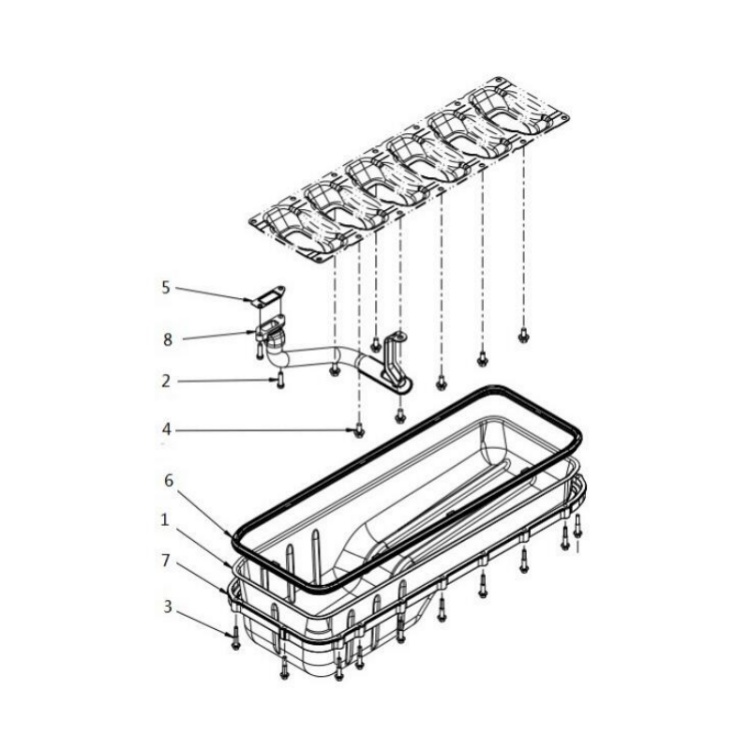
1. Clean: Thoroughly clean the surface of the oil suction pipe, the interface and the filter screen from oil, iron chips and impurities to ensure the inner wall is smooth and unobstructed; clean the oil pump inlet interface and the oil pan installation position to avoid residual impurities affecting the seal and oil circuit smoothness.
2. Inspect: The new oil suction pipe has no deformation, rust or cracks, the interface has no burrs, and the filter screen is intact without damage or blockage; check that the length and interface size of the oil suction pipe are fully matched with the installation position, and the bracket has no deformation.
3. Install: First, smoothly put the end of the oil suction pipe with the filter screen into the designated position of the oil pan, align with the oil pump inlet interface, put on the C4898301 seal, adjust the position of the oil suction pipe to ensure no distortion or looseness, then fix the bracket and interface with bolts.
4. Torque: Tighten the interface connecting bolts crosswise in 2 steps to 20~30N·m, and tighten the bracket bolts synchronously to ensure that the oil suction pipe is closely connected with the oil pump and oil pan, without loose gaps, so as to avoid interface leakage caused by engine vibration.
5. Re-inspect: After installation, check that the oil suction pipe has no shaking and the filter screen is attached to the bottom of the oil pan; after adding oil, start the engine to idle, observe no leakage at the interface, normal oil pressure and no abnormal noise.
6. Maintenance: Check the state of the oil suction pipe and clean the filter screen impurities during each engine oil change or maintenance; if the oil suction pipe is deformed, rusted, cracked or the filter screen is blocked, replace C5274750 in time; regularly check the interface seal and tighten loose bolts.