C3954111 (3954111) is a genuine Cummins locating ring, a key auxiliary component for the engine valve train and transmission system. Made of high-quality alloy steel through precision machining with anti-corrosion surface treatment, it is used for radial positioning and axial limiting of key engine components such as camshafts, bearing seats, and valve assemblies. It restricts radial runout and axial movement of components, ensuring coaxiality and fitting accuracy of moving parts, and reducing operational wear. It fits Cummins QSB6.7, ISB6.7, ISDe and other series diesel engines, and is widely used in construction machinery, commercial vehicles, generator sets and other heavy-duty equipment.
Technical Parameters
– Part Number: C3954111 (3954111)
– Description: LOCATING RING, ENGINE
– Cross Reference: 3903473, 4934862 (for same size camshaft/bearing seat)
– Material: 45# high-quality alloy steel (surface oxidation/phosphating treatment)
– Type: Shaft Locating Ring (external positioning)
– Inner Diameter: 45.0~45.2mm (fits 45mm shaft diameter components)
– Outer Diameter: 55.0~55.3mm
– Thickness: 5.8~6.2mm
– Roundness: ≤0.02mm
– Hardness: HRC30~35 (quenched and tempered)
– Operating Temperature: -40℃~+250℃
– Tensile Strength: ≥800MPa
– Surface Treatment: Black oxidation (anti-corrosion, anti-wear)
– Weight: Approx. 0.08kg
– Standards: Cummins OEM, ISO 9001, TS16949
Application
Applicable Engines
– Cummins QSB6.7 (6D107) series electronic diesel engines
– Cummins ISB6.7 series electronic diesel engines
– Cummins ISDe4.5, ISDe6.7 series electronic diesel engines
– Komatsu SAA6D107E-1 (for PC200-8/220-8)
– Matching Piston Model: 4934860 (C4934860), Camshaft Model: C3974642
Equipment
– Excavators: Komatsu PC200-8, PC220-8, Hyundai R290LC-9, Sany SY215C
– Loaders: Hyundai HL730-7A/9, HL740-7A/9, Liugong CLG856H
– Commercial Vehicles: Dongfeng Kinland, Foton Aumark, JAC格尔发 (equipped with ISB/QSB/ISDe engines)
– Gensets: 150–250kW Cummins QSB6.7, ISDe6.7 series diesel units
– Industrial Equipment: Air compressors, water pump units, oilfield machinery, marine auxiliary power equipment (matching the above engines)
Mounting Location
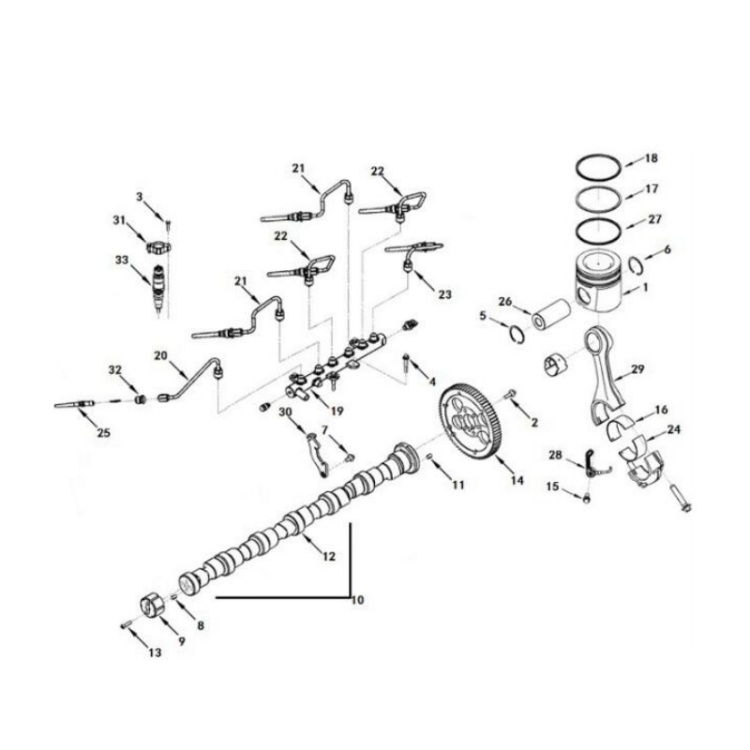
Mainly installed at the end of the camshaft, inside the bearing seat or at the valve guide seat hole. Depending on the model, it is installed as a single piece or two symmetrical pieces; it is sleeved on the outside of the shaft component and embedded in the corresponding groove, working together with C3920691 snap ring, 4934860 piston and other components to achieve precise positioning of the camshaft and valve assembly, ensure accurate valve timing, and avoid component operation offset.
Installation & Maintenance
1. Clean: Thoroughly clean carbon deposits, oil stains and metal debris on the installation groove and the surface of the shaft component to ensure the installation surface is flat, free of burrs, scratches and deformation.
2. Inspect: C3954111 has no deformation, cracks or wear; no ellipse or strain on the inner and outer circles; no rust on the surface, no peeling of the oxide layer; the size meets the standard and fits closely with the installation position.
3. Install: Use press-fitting or cold-fitting method to smoothly embed the locating ring into the groove, ensuring it is fully clamped without loosening or offset; after installation, check the fit between the end face of the locating ring and the component, with no gap.
4. Matching: After installation, check that the associated components (camshaft, bearing seat, etc.) rotate flexibly without jamming; the fit gap between the locating ring and the shaft component, groove is controlled at 0.01~0.03mm.
5. Replace: When the locating ring is worn, deformed, rusted or the fit gap exceeds the limit, it must be replaced in time; when disassembling and assembling associated components (such as camshaft, bearing seat), it is recommended to replace the locating ring synchronously.
6. Maintain: Check the status of the locating ring every 1000 hours, focusing on wear, rust and fit gap; avoid tapping the locating ring with sharp tools to prevent deformation or damage to the installation surface.
Fault Symptoms
– Abnormal noise during engine operation (metal friction sound, knocking sound)
– Camshaft movement and excessive radial runout, leading to valve timing deviation and power loss
– Locating ring wear and fall-off, causing increased wear of bearing seats and shaft components, and even jamming
– Abnormal valve movement, such as air leakage, backfire, poor exhaust and other problems
– Abnormally high oil consumption, metal debris in engine oil (generated by locating ring wear)
– Engine jitter, unstable idle speed, and failure to start or operate normally in severe cases