We’re happy to help you find the best option for your application.
Model: 3461703
Material: Typically made of low-carbon steel (such as Q235), stainless steel, or spring steel, etc.
Operating Temperature: Depends on the material
Surface Treatment: Commonly includes galvanizing, bluing (blackening), chrome plating, etc.
Model: 3461703, a specific part number for a standard locking plate. Its dimensions, bore diameter, angle, and other parameters are precisely matched to the target fastener.
Material: Typically made of low-carbon steel (such as Q235), stainless steel, or spring steel, formed by stamping, possessing a certain degree of elasticity and strength.
Operating Temperature: Depends on the material. Ordinary carbon steel locking plates are suitable for ambient temperatures from -20℃ to 120℃, while spring steel locking plates have a wider temperature range.
Surface Treatment: Common treatments include galvanizing, bluing (blackening), and chrome plating, primarily for rust and corrosion prevention, and also for aesthetic purposes.
Specifications and Dimensions: Key dimensions include inner hole/bore diameter (matching the bolt or shaft diameter), outer diameter/contour dimensions, locking bend angle, and length, which must strictly comply with installation requirements.
Locking Method: Mechanical locking, relying on the bent portion of the locking plate (“locking lug” or “locking tongue”) to engage with the nut groove, part groove, or bend tightly against the part plane to prevent loosening.
As a passive mechanical anti-loosening component, its core function is to prevent threaded connections (such as nuts, slotted nuts) or grooved/holeed shaft parts from rotating loosening or even falling off under long-term operation of equipment, especially under continuous vibration and impact conditions. By fitting the locking plate’s center hole or inner tongue onto the bolt or shaft, and bending its outer tongue (locking lug) to tightly engage with and lock into the groove of the adjacent nut or against the part plane, the rigidity of the metal restricts the rotational freedom of the locked part. It has a simple structure, low cost, high reliability, and low reusability (usually disposable or requiring replacement), making it a fundamental standard component for ensuring the safety of critical connection points in engineering machinery, vehicles, aerospace, and other fields.
Widely used in environments with strong vibration and impact loads, such as construction machinery, heavy vehicles, rail transportation, and aerospace equipment. In construction machinery, they are commonly found at bolted connections in critical components such as engines, gearboxes, traveling mechanisms, and working devices. Examples include nuts used to lock the bolts securing the travel motor, nuts on the bolts connecting the slewing bearing, and flange connection nuts for hydraulic lines.

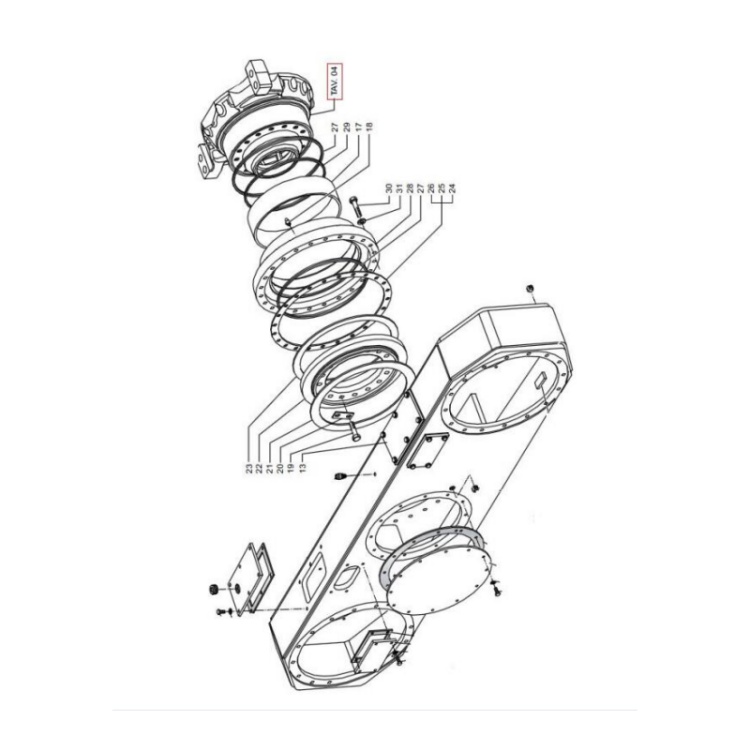
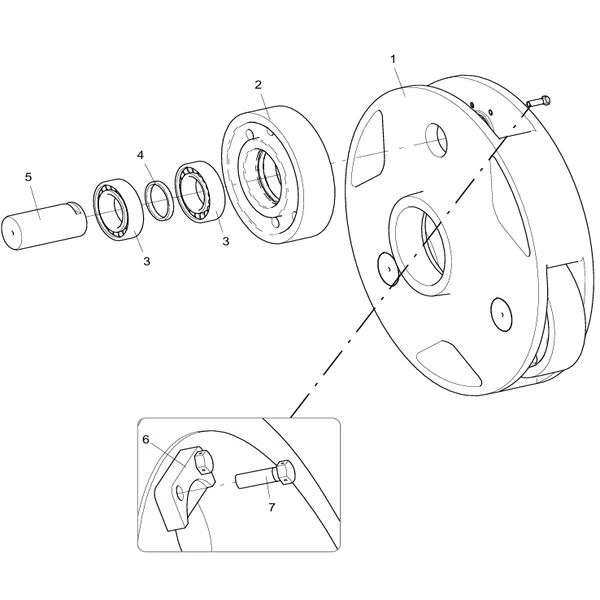
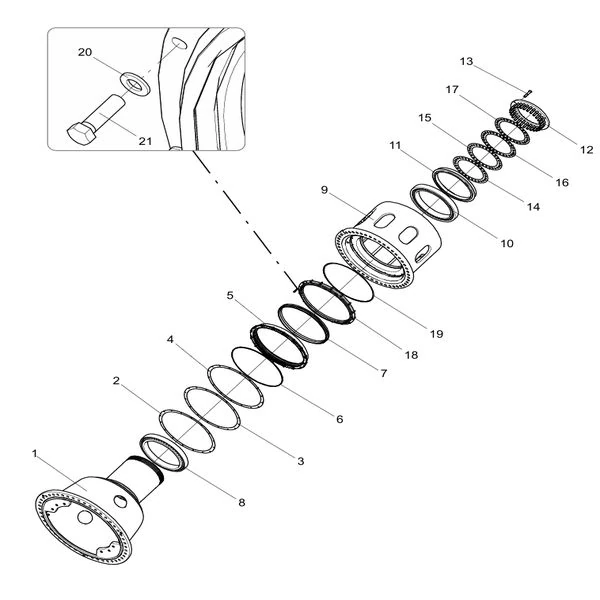
17 3454023 Set
18 72637 Lubricating Oil Cup
19 70262 Bolt M20×1.5×70
20 3461703 Locking Plate
21 3454043 Washer
22 3349823 Disc
23 3454033 Washer
24 3349913 Adjusting Shim 0.45
25 3463783 Adjusting Shim 0.18
26 3349903 Adjusting Shim 0.15
27 3516073 Seal
28 3454813 Support
29 70398 O-ring
*For other spare parts procurement needs, please contact us!